Forschungsvereinigungen müssen für die Antragstellung im Rahmen der IGF autorisiert sein. Noch nicht autorisierte Forschungsvereinigungen können einen Antrag auf Autorisierung im Förderprogramm Industrielle Gemeinschaftsforschung (IGF) stellen, wenn die Kriterien gemäß der Anlage Förderrichtline erfüllt sind.
Die Industrielle Gemeinschaftsforschung (IGF) ist ein europaweit einzigartiges, themenoffenes und vorwettbewerbliches Förderprogramm des Bundesministeriums für Wirtschaft und Energie (BMWE), das kleinen und mittleren Unternehmen (KMU) einen einfachen Zugang zu praxisorientierter Forschung ermöglicht.
Eine Kurzdarstellung veranschaulicht den Prozess von der Idee bis zur Veröffentlichung des Forschungsergebnisses.
Hier finden Sie eine Übersicht aller IGF-Forschungsvereinigungen.
IGF bewegt: Erhalten Sie in Bild und Ton Einblicke in die IGF.
Mit den Mitteln der IGF werden im transnationalen Netzwerk CORNET auch Projekte gemeinsam mit internationalen Kooperationspartnern durchgeführt ...
Im Rahmen des IGF-Kongresses wurde das IGF-Projekt des Jahres 2025 gewählt. Unter 23 Einreichungen hat der Wissenschaftliche Rat der IGF drei Finalisten nominiert. Das Gewinner-Team wurde durch das Publikum gewählt.
Ein kleiner Ausschnitt der bisher rund 12000 geförderten Projekte bietet einen Einblick in die Vielfalt der Forschungsthemen.
Die Projektdatenbank der Industriellen Gemeinschaftsforschung (IGF) umfasst rund 12000 abgeschlossene und laufende IGF-Vorhaben seit dem Jahr 1995 und wird regelmäßig aktualisiert.
Hier finden Sie Veranstaltungen mit Bezug zu IGF-Forschungsvorhaben.
PSE2026 - 20th International Conference on Plasma Surface Engineering
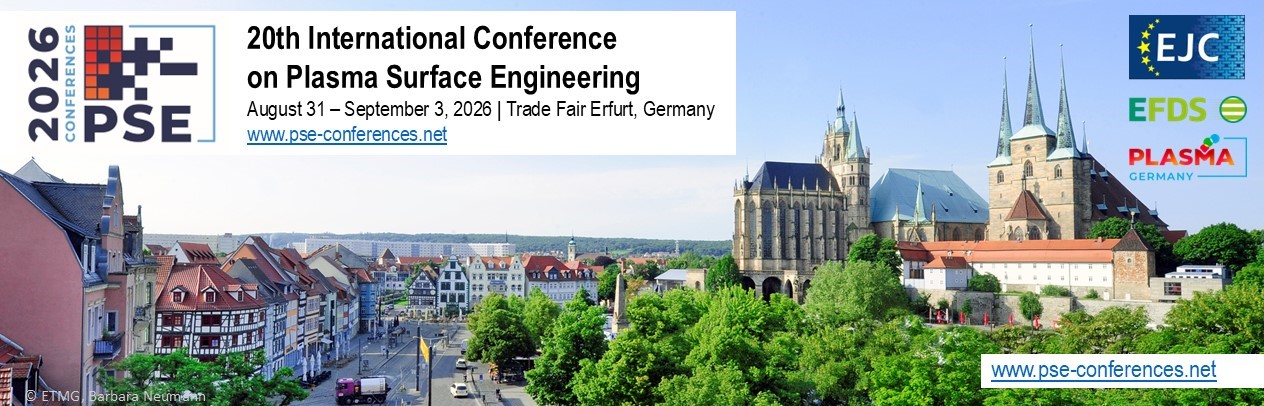
PSE2026 will take place in Erfurt in Germany. PSE Conferences offer a vibrant platform for exchanging the latest advances in research, development, and industrial applications. Contributions from both academia and industry are warmly welcome. The event fosters collaboration, discussion and innovation, connecting experts to explore how fundamental insights translate into practical solutions.
PSE2026 will take place from August 31 – September 3, 2026 at Trade Fair Erfurt in Germany. PSE Conferences offer a vibrant platform for exchanging the latest advances in research, development, and industrial applications. Contributions from both academia and industry are warmly welcome. The event fosters collaboration, discussion and innovation, connecting experts to explore how fundamental insights translate into practical solutions. The conference is framed by inspiring plenary lectures and motivating role models, highlighting key trends and achievements. Detailed conference topics are highlighted in the adjacent panel.
The international event is accompanyed by an industrial exhibition. It is more than just a showcase, the exhibition is the beating heart of the conference. From coating
machines and plasma technologies to advanced materials, analytics, and automation – here you will find the innovations shaping the future of surface engineering. Meet leading providers, exchange ideas with international experts, and seize opportunities for new collaborations. Networking, discussions, customer care, and social events all take place right here.
At PSE2026 we expact nearly 600 participants and 70 exhibitiors.
Conference Topics: Plasma and ion sources, Process Technologies, Properties and applications, Characterization and simulation
MAIN TOPIC: “Surface engineering for clean energy solutions”
TREND TOPIC: „Thin films and micro structuring methods for integrated smart systems“
WEBINAR: „Space2Motion trifft Dünnschichttechnik“
The workshop focuses on innovative coating and thin-film technologies specifically developed and used for applications in the aerospace industry. The topics covered include functional coatings for extreme operating conditions, such as thermal barriers, corrosion protection systems and erosion-resistant coatings for engine components and external structures. Another key focus is on thin-film technologies for sensor technology and electronics, in particular the integration of micro- and nanosensors into modern aircraft systems and satellite platforms.
In addition, plasma and PVD processes in the aerospace sector will be presented, with a focus on process optimisation, scalability and quality assurance. The programme will be complemented by presentations on material characterisation and service life analysis, such as the evaluation of coating adhesion, microstructure and long-term behaviour under real-world operating conditions. Aspects of sustainability and resource efficiency will also be addressed – for example, through the development of environmentally friendly coating processes and recyclable coating systems.
Keynote speeches by
- Dr.-Ing. Asim Mirza | boltzplatz – numerical plasma dynamics GmbH
- Vanja Sebastian Zander | DLR German Aerospace Center
- Peter Becker M.Sc., EurA AG, Niederlassung Aachen | Eura Ag, Niederlassung Aachen
- Barbara Putz | Empa Swiss Federal Laboratories for Materials Science and Technology
- Klaus Boebel | Oerlikon Surface Solutions AG, Pfäffikon (LI)
The program is currently being prepared and will be posted here shortly!
The two-day webinar will take place on both days from 9.00 am to 11.00 am.
Please note that the event will be held in German!
Veranstaltungsort: Online via MS Teams
Ansprechpartnerin: Ingrid Gläser
Telefon: +49 351 871-8370
E-Mail: glaeser@efds.org
Veranstaltungs-Link: https://efds.org/en/event/efds-webinar-space2motion-meets-thin-film-technology/
Workshop „Innovative Beschichtungstechnologien für Werkzeuge: Potentiale und Herausforderungen“
Die fortschreitende Entwicklung innovativer Beschichtungstechnologien eröffnet neue Möglichkeiten zur Leistungssteigerung und Lebensdauerverlängerung von Werkzeugen. Im Rahmen unseres Workshops „Innovative Beschichtungstechnologien für Werkzeuge: Potentiale und Herausforderungen“ am 28.10.2026 beleuchten Experten aus Forschung und Praxis aktuelle Trends, technologische Fortschritte sowie bestehende Herausforderungen im Bereich moderner Beschichtungssysteme. Nutzen Sie die Gelegenheit zum fachlichen Austausch und erhalten Sie wertvolle Einblicke in zukunftsweisende Lösungen für die industrielle Anwendung.
Veranstaltungsort: GFE Schmalkalden e.V., Näherstiller Straße 10, 98574 Schmalkalden
Ansprechpartnerin: Linda Kappler
Telefon: +49 351 871-8375
E-Mail: kappler@efds.org
Veranstaltungs-Link: https://efds.org/event/ws-werkzeugbeschichtung/
Workshop „MEMS 2027 – Dünnschichttechnik als Schlüssel zur Sensorik von morgen“
Die Anforderungen an moderne Sensor- und Messsysteme wachsen stetig: Höhere Präzision, zunehmende Miniaturisierung, intelligente Datenverarbeitung und neue Anwendungsfelder treiben die Entwicklung innovativer Technologien voran. Mikroelektromechanische Systeme (MEMS), Photonik und Dünnschichttechnologien spielen dabei eine Schlüsselrolle und bilden die Grundlage für zahlreiche Anwendungen in Industrie, Medizintechnik, Umweltmonitoring, Kommunikation und automatisierter Fertigung.
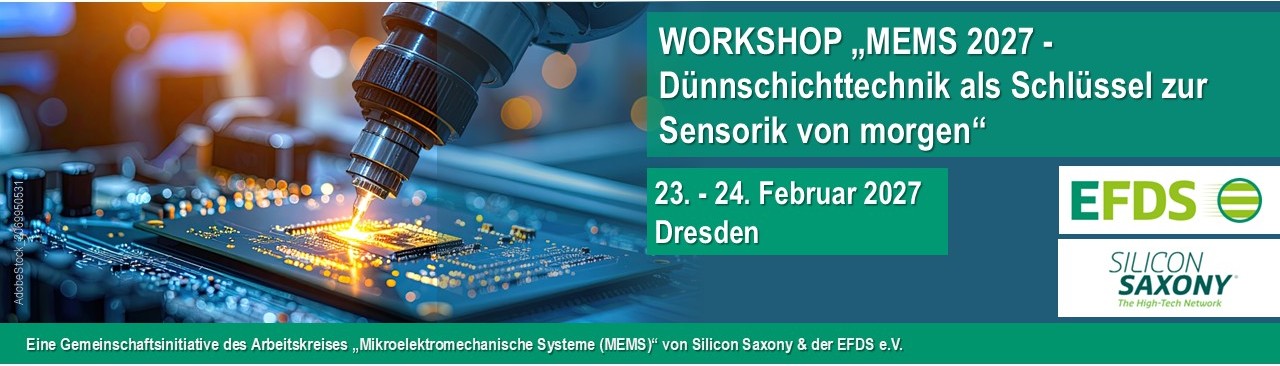
Der Workshop MEMS 2027 – Dünnschichttechnik als Schlüssel zur Sensorik von morgen bringt am 23. und 24. Februar 2027 in Dresden Fach- und Führungskräfte aus Industrie, Forschung und Entwicklung zusammen. Die Veranstaltung bietet eine Plattform für den fachlichen Austausch über aktuelle Entwicklungen und zukünftige Technologietrends an der Schnittstelle von MEMS, integrierter Photonik, Mikroelektronik und intelligenter Sensorik.
Im Mittelpunkt stehen innovative Lösungen wie MEMS-basierte LiDAR-Systeme, nanophotonische Biosensoren, abstimmbare MEMS-Laser und spektrale Filtersysteme, optofluidische MEMS für chemische und biologische Analysen sowie Photonik-MEMS-Anwendungen für IoT- und Edge-Sensorik. Darüber hinaus werden neue Ansätze rund um quantenbasierte MEMS-Komponenten und den Einsatz von Künstlicher Intelligenz zur Echtzeitauswertung von Sensordaten vorgestellt.
Die Teilnehmerinnen und Teilnehmer erhalten einen umfassenden Überblick über aktuelle Forschungsarbeiten, industrielle Entwicklungen und zukunftsweisende Anwendungsfelder. Praxisnahe Vorträge, Diskussionen und Networking-Möglichkeiten fördern den Wissenstransfer und schaffen Raum für neue Kooperationen zwischen Forschungseinrichtungen, Technologieanbietern und Anwendern.
Die Veranstaltung wird von der Europäischen Forschungsgesellschaft Dünne Schichten (EFDS) gemeinsam mit Silicon Saxony e. V. organisiert und fachlich durch den Arbeitskreis „Mikroelektromechanische Systeme (MEMS)“ begleitet.
Nutzen Sie die Gelegenheit, sich mit führenden Expertinnen und Experten auszutauschen und die Technologien kennenzulernen, die die Sensorik von morgen prägen werden.
Ansprechpartnerin: Udo Klotzbach / Ingrid Gläser
Telefon: +49 351 871-8370
E-Mail: info@efds.org
Veranstaltungs-Link: https://efds.org/event/workshop-mems-2027/